Windows Kernel Vulnerability Zero Day Found in
Duqu Installer.
A malware attack
Duqu exploits a zero-day vulnerability in the Windows kernel, according to security researchers (like cyber-surveillance Trojan).
The vulnerability has since been reported to
Microsoft and
Microsoft is currently working on a patch for the kernel vulnerability. Researchers from the Laboratory of Cryptography and System Security (
CRYSYS) in Hungary confirmed the existence of the zero-day vulnerability and exploit in a brief note published on their website.
Our laboratory, the Laboratory of Cryptography and System Security (CRYSYS) has continued to analyze the Duqu malware and as a result of our investigation, we identified a dropper file with an MS 0-day kernel exploit inside. We immediately provided the competent organizations with the necessary information so they can take appropriate measures to protect users.
The installation file is a document
Microsoft Word (.doc) that exploits a previously unknown kernel vulnerability, which allows code execution.
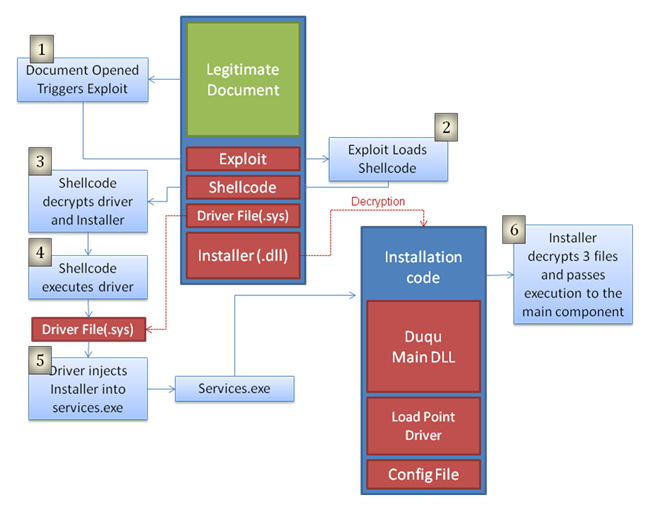
When the file is opened, the malicious code executes and installs the main
Duqu binaries. The table above explains how exploiting in the Word document file eventually leads to the installation of Duqu.
Meanwhile, an expert
Microsoft highlights the imminent arrival of
Windows 8 (basically it is DTC for the 0-day flaw

)
[url=https://www..com/connect/w32-duqu_status-updates_installer-zero-day-exploit]Source[/url]
Vulnérabilité du noyau Windows Zero Day Trouvé dans
Duqu Installer.
Une attaque de malware
Duqu exploite une vulnérabilité zero-day dans le noyau Windows, selon les chercheurs en sécurité (comme la cyber-surveillance de Troie).
La vulnérabilité a depuis été signalés à
Microsoft et
Microsoft travaille actuellement sur un correctif pour la vulnérabilité du noyau. Des chercheurs du Laboratoire de Cryptographie et Sécurité du système (
CRYSYS) en Hongrie a confirmé l'existence de la vulnérabilité zero-day et exploiter dans une brève note publiée sur son site Web.
Notre laboratoire, le Laboratoire de Cryptographie et Sécurité du système (CRYSYS) a poursuivi l'analyse des logiciels malveillants Duqu et comme un résultat de notre enquête, nous avons identifié un fichier compte-gouttes avec une MS 0-day exploit du noyau à l'intérieur. Nous avons immédiatement fourni aux organisations compétentes les informations nécessaires, telles qu'elles peuvent prendre des mesures appropriées pour la protection des utilisateurs.
Le fichier d'installation est un document
Microsoft Word (. doc) qui exploite une vulnérabilité du noyau jusque-là inconnues, qui permet l'exécution de code.
Lorsque le fichier est ouvert, le code malveillant s'exécute et installe les principaux
Duqu binaires. Le tableau ci-dessus explique comment les exploiter dans le fichier de document Word conduit finalement à l'installation de Duqu.
En attendant, un expert
Microsoft souligne l'arrivé proche de
Windows 8 (en gros il est DTC pour la faille 0-day
)
[url=https://www..com/connect/w32-duqu_status-updates_installer-zero-day-exploit]Source[/url]

 Everything for PC